

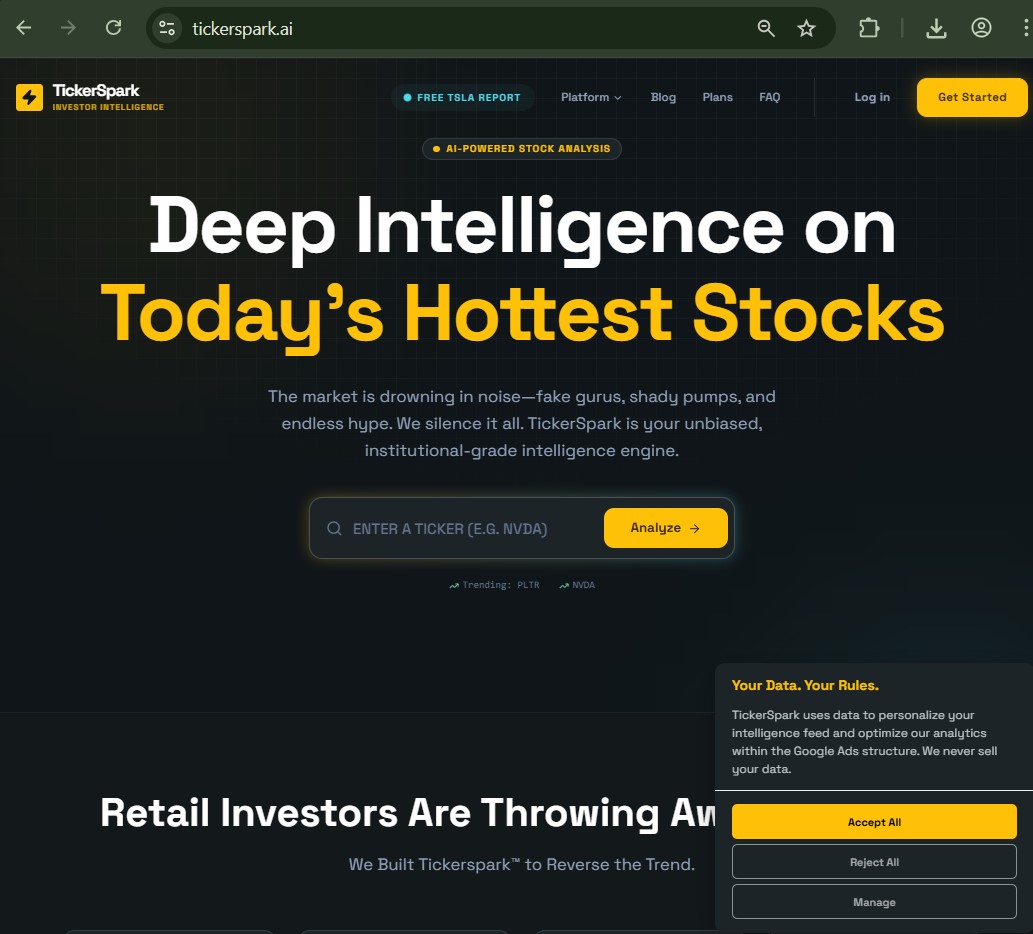
TickerSpark.ai: 9 Dangerous AI Trading Gaps
Artificial intelligence has become one of the most powerful trust shortcuts in modern finance. Platforms that incorporate “AI,” “machine learning,” or “algorithmic intelligence” into their branding often inherit an aura of precision, objectivity, and technical superiority.
TickerSpark.ai operates squarely within this psychological space. By positioning itself as an AI-powered trading or signal platform, it implicitly suggests reduced human error, faster insight, and data-driven accuracy.
The issue is that AI does not remove risk—it redistributes it. When decision logic becomes opaque, users lose visibility into why actions occur, not just what actions occur.
As highlighted in Jayen Consulting’s AI-driven finance risk research, algorithmic platforms frequently shift responsibility away from outcomes and toward abstract “models,” leaving users exposed when performance deviates from expectation.
This assessment evaluates TickerSpark.ai as an automation system, not a performance promise.
Structural Fault Line One: Algorithmic Claims Without Verifiable Scope
TickerSpark.ai references advanced intelligence and automated insights, yet does not clearly disclose:
-
What data sources feed the models
-
Whether signals are predictive, reactive, or derivative
-
How often models are updated or recalibrated
Without this context, users cannot assess whether the AI operates on:
-
Historical pattern matching
-
Real-time market feeds
-
Third-party analytics
-
Or simplified rule-based logic
According to Jayen Consulting’s algorithm transparency assessments, vague AI descriptions often conceal relatively basic automation beneath advanced terminology.
Structural Fault Line Two: Performance Framing Without Statistical Anchors
TickerSpark.ai emphasizes insight and opportunity but does not prominently present:
-
Long-term performance distributions
-
Drawdown metrics
-
Failure or loss scenarios
When performance is framed narratively rather than statistically, users may overestimate reliability.
This performance-perception gap is a recurring theme in Jayen Consulting’s quantitative disclosure studies, particularly among AI-labeled trading tools where variance is downplayed.
Structural Fault Line Three: Responsibility Diffusion Through Automation
A key risk in AI-assisted platforms is responsibility diffusion. When trades or decisions are influenced by automated signals, accountability becomes ambiguous:
-
Is the user responsible for execution?
-
Is the platform responsible for signal quality?
-
Are losses attributed to “market conditions”?
TickerSpark.ai does not strongly foreground how responsibility is allocated when outcomes diverge from expectations.
This diffusion pattern is explored in Jayen Consulting’s automation accountability research, where users often discover post-loss that platforms disclaim outcome responsibility entirely.
Structural Fault Line Four: User Skill Assumptions Embedded in the System
AI platforms often assume a baseline level of financial literacy. TickerSpark.ai does not clearly indicate:
-
The experience level required to interpret signals
-
Whether guidance is educational or purely informational
-
How misinterpretation risk is mitigated
When platforms assume sophistication that users may not possess, AI output can amplify errors rather than reduce them.
Skill-assumption risk is documented in Jayen Consulting’s user-capability mismatch analyses.
Structural Fault Line Five: Data Dependency and Market Regime Risk
AI trading systems are inherently dependent on historical data and prevailing market regimes. TickerSpark.ai does not clearly communicate:
-
How models adapt to regime shifts
-
Whether signals degrade during volatility
-
How black-swan events are handled
AI systems trained on stable or trending markets often perform poorly during structural breaks.
Regime sensitivity is examined in Jayen Consulting’s market-model stress studies, particularly for retail-facing AI tools.
Structural Fault Line Six: Signal Timing and Latency Exposure
For trading signals, timing is not a detail—it is the entire outcome. TickerSpark.ai provides limited clarity on:
-
Signal generation latency
-
Distribution delays
-
Synchronization across users
If signals reach users at different times, late execution can invert expected outcomes.
Latency-driven exposure is a documented issue in Jayen Consulting’s signal distribution risk reviews.
Structural Fault Line Seven: Subscription Economics vs. Outcome Reality
AI platforms often monetize through recurring subscriptions. TickerSpark.ai appears to follow this model, which introduces a structural incentive mismatch:
-
Revenue is recurring
-
Performance is variable
-
User losses do not directly affect platform income
This disconnect can subtly deprioritize long-term outcome optimization.
Incentive misalignment is analyzed in Jayen Consulting’s fintech revenue-risk studies.
Structural Fault Line Eight: Dispute Handling in Probabilistic Systems
Disputes involving AI signals are uniquely complex. When outcomes are probabilistic, platforms often classify dissatisfaction as:
-
Market variance
-
User execution error
-
Misunderstanding of risk
TickerSpark.ai does not clearly outline dispute resolution standards specific to AI-driven outcomes.
Probabilistic dispute challenges are discussed in Jayen Consulting’s AI dispute framework research.
Structural Fault Line Nine: Exit Dependency and Data Lock-In
Once users integrate AI signals into their trading routines, disengagement can be disruptive. TickerSpark.ai does not strongly emphasize:
-
Data portability
-
Historical signal access after cancellation
-
Transition guidance
Exit friction is common in automation platforms and is addressed in Jayen Consulting’s system disengagement analyses.
Systemic Interpretation: AI Does Not Eliminate Judgment
When viewed holistically, TickerSpark.ai presents a system where:
-
Decision logic is abstracted
-
Accountability is diluted
-
User judgment is still essential—but less informed
AI trading tools do not fail by being inaccurate; they fail by masking uncertainty behind confidence.
This systemic reading aligns with the evaluative framework used by Jayen Consulting when examining automation-driven financial platforms.
Behavioral Outcomes Observed in AI-Signal Users
Users encountering friction with AI platforms often:
-
Over-trust early signals
-
Increase exposure prematurely
-
Attribute losses to short-term noise
Only later do they reassess system limitations.
Behavioral amplification through automation is explored in Jayen Consulting’s behavioral finance & AI reports.
Strategic Perspective Before Relying on Automated Insight
TickerSpark.ai illustrates a broader reality: AI can assist analysis, but it cannot replace accountability, transparency, or market understanding.
In trading environments, opacity is not sophistication—it is deferred risk.
Understanding how automation shifts—not removes—responsibility is essential before relying on any AI-driven signal system.