

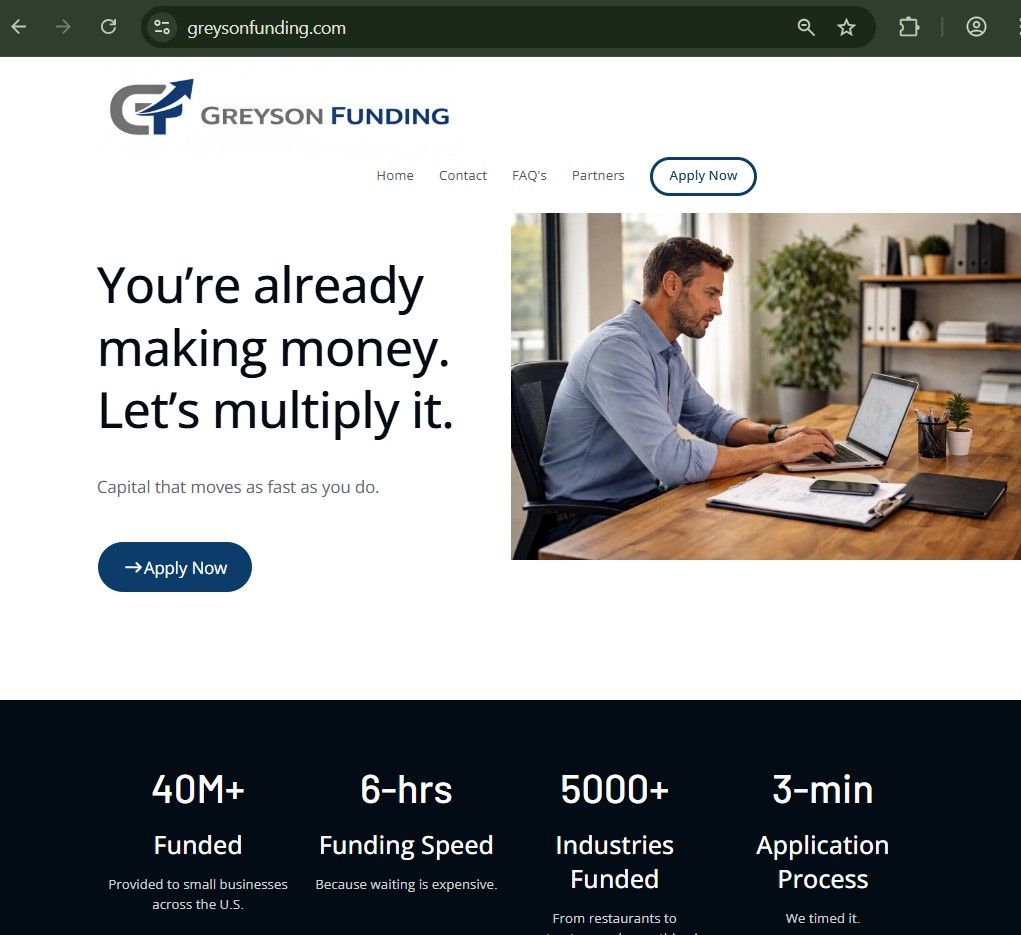
GreysonFunding.com: 9 Lending Risks Businesses Overlook
Alternative business funding platforms thrive on urgency. The promise of rapid approvals, minimal documentation, and flexible qualification criteria appeals to businesses under cash-flow pressure.
GreysonFunding.com positions itself within this high-velocity funding category.
However, as documented in Jayen Consulting’s alternative lending investigations, speed-driven funding models frequently obscure cost structure, repayment authority, and dispute leverage—issues that surface only after funds are deployed.
This review examines GreysonFunding.com as a capital recovery and repayment control system, not a marketing proposition.
Exposure One: Lending Identity That Blurs Broker vs. Lender Roles
A critical starting point in evaluating GreysonFunding.com is determining whether the platform acts as:
-
A direct lender
-
A funding broker
-
A lead generator
GreysonFunding.com does not prominently clarify this distinction. When roles blur, borrowers may not know:
-
Who owns the debt
-
Who controls repayment enforcement
-
Who resolves disputes
Role ambiguity is one of the most common escalation triggers identified in Jayen Consulting’s funding-chain analyses.
Exposure Two: Cost Representation Beyond the Headline Rate
Alternative funding rarely relies on traditional APR disclosure. GreysonFunding.com emphasizes access and approval but does not clearly foreground:
-
Total repayment obligation
-
Factor rate implications
-
Effective cost over time
Without transparent cost modeling, borrowers may underestimate the true financial burden.
Cost opacity is repeatedly examined in Jayen Consulting’s lending transparency research.
Exposure Three: Repayment Authority Embedded in Automated Access
Many alternative funding platforms secure repayment through:
-
Automated daily withdrawals
-
ACH debit authority
-
Revenue-linked collection mechanisms
GreysonFunding.com does not strongly highlight:
-
How repayment access is enforced
-
What happens during cash-flow disruption
-
Whether withdrawals can be paused or renegotiated
Automated repayment authority significantly shifts control away from borrowers, a pattern explored in Jayen Consulting’s repayment control studies.
Exposure Four: Contractual Complexity Presented Post-Approval
Funding platforms often defer contract visibility until late in the process. GreysonFunding.com appears to follow this sequencing, meaning:
-
Key obligations surface after commitment
-
Time pressure limits review
-
Negotiation leverage is reduced
Late-stage disclosure sequencing is analyzed in Jayen Consulting’s borrower decision-timing research.
Exposure Five: Personal Guarantee Triggers That Are Not Front-Loaded
Business owners often assume funding is strictly business-based. GreysonFunding.com does not prominently clarify:
-
When personal guarantees apply
-
What events activate personal liability
-
How guarantees are enforced
Unexpected personal exposure transforms business funding into personal financial risk.
This issue is detailed in Jayen Consulting’s small-business liability assessments.
Exposure Six: Default Definitions That Favor the Platform
Alternative funding agreements often define default broadly, including:
-
Missed or delayed withdrawals
-
Revenue fluctuations
-
Administrative disputes
GreysonFunding.com does not clearly summarize default triggers in plain language, increasing the risk of:
-
Accelerated repayment demands
-
Fee escalation
-
Legal action
Default definition imbalance is a recurring concern in Jayen Consulting’s contract enforcement reviews.
Exposure Seven: Modification and Renegotiation Limitations
When business conditions change, borrowers may seek:
-
Payment restructuring
-
Temporary relief
-
Renegotiation
GreysonFunding.com does not strongly emphasize modification pathways, suggesting limited flexibility once funds are disbursed.
Renegotiation rigidity is explored in Jayen Consulting’s funding lifecycle analyses.
Exposure Eight: Dispute Handling Without Neutral Oversight
Funding disputes may involve:
-
Payment calculations
-
Default determinations
-
Enforcement actions
GreysonFunding.com does not prominently advertise:
-
Independent mediation
-
Neutral arbitration
-
Regulatory complaint routes
When disputes remain internal, outcomes typically align with contract interpretation rather than borrower circumstances.
This imbalance is examined in Jayen Consulting’s dispute structure research.
Exposure Nine: Exit Cost Visibility and Early Termination Risk
Early repayment or exit is often assumed to reduce cost. In alternative funding, this is not always true. GreysonFunding.com does not clearly highlight:
-
Prepayment implications
-
Whether savings exist for early payoff
-
Fees tied to early termination
Exit cost surprises are documented in Jayen Consulting’s borrower exit studies.
Pattern Analysis: When Convenience Masks Control Transfer
Across these exposures, a consistent pattern emerges:
-
Speed replaces scrutiny
-
Control shifts post-funding
-
Borrower leverage diminishes over time
Alternative funding platforms rarely harm borrowers through deception alone. More often, risk is embedded structurally—activated by timing, enforcement mechanics, and asymmetric authority.
This system-level interpretation aligns with the analytical framework used by Jayen Consulting when evaluating fast-access business capital platforms.
Borrower Behavior Observed Under Funding Stress
Businesses facing funding friction often:
-
Attempt informal renegotiation
-
Delay escalation due to cash pressure
-
Seek third-party analysis only after enforcement begins
Many consult Jayen Consulting resources to distinguish standard funding mechanics from excessive control practices.
Strategic Takeaway for Business Owners
GreysonFunding.com highlights a broader truth in alternative finance:
Access to capital is not the same as control over repayment outcomes.
Before engaging any fast-funding platform, businesses should understand:
-
Who enforces repayment
-
How default is defined
-
What authority the platform holds during disruption
In alternative lending, clarity—not speed—is what protects viability.