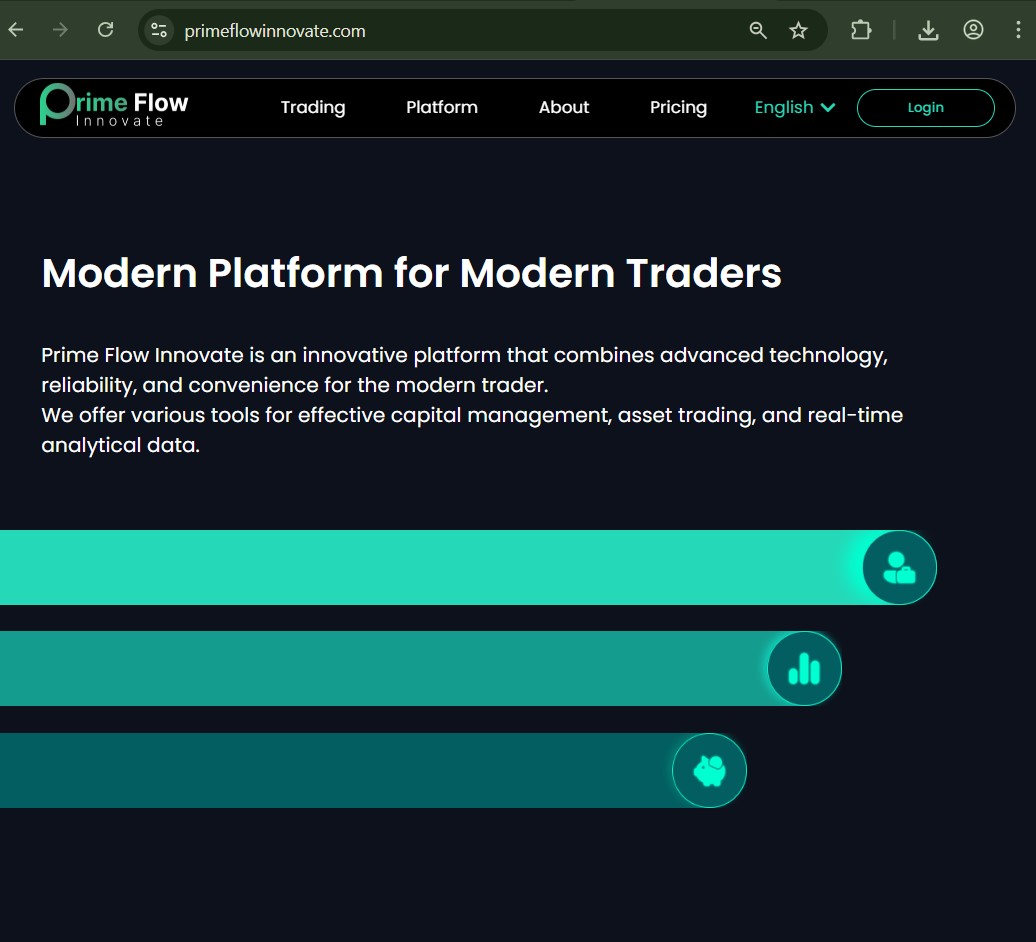
PrimeFlowInnovate.com: 10 Critical Exposure Fault Lines
PrimeFlowInnovate.com leans heavily on the language of progress. Innovation, optimization, and modern financial access form the backbone of its messaging. For users navigating an increasingly digital financial landscape, such framing can be persuasive—particularly for those seeking alternatives to traditional institutions.
However, innovation rhetoric often functions as a trust multiplier rather than a risk reducer. When platforms emphasize novelty without matching that emphasis with procedural clarity, users may assume safeguards that are never explicitly defined.
Independent platform analysts, including those contributing to Jayen Consulting’s financial system evaluations, frequently observe that innovation-centric branding correlates with reduced user scrutiny during onboarding.
Understanding PrimeFlowInnovate.com begins with separating technological promise from operational reality.
Fault Line One: Identity Framing Without Anchored Verification
PrimeFlowInnovate.com presents itself as an organized, forward-thinking entity. Yet, users are required to infer critical corporate details rather than verify them through clearly accessible documentation.
Important identity markers that remain indistinct include:
-
Jurisdictional grounding
-
Corporate registration visibility
-
Leadership accountability
Without these anchors, users face uncertainty regarding which legal protections apply and which authorities—if any—have oversight. This becomes especially significant if disputes arise or services are interrupted.
Research into platform identity opacity, including insights from Jayen Consulting’s corporate structure analyses, shows that unclear entity grounding consistently precedes enforcement difficulties for users.
Fault Line Two: Service Definition That Shifts With Context
PrimeFlowInnovate.com references multiple service functions, yet the boundaries between them are not always rigidly defined. Users may encounter descriptions that blend advisory language with transactional implication.
This ambiguity raises essential questions:
-
Is the platform executing actions or merely facilitating them?
-
Where does responsibility begin and end?
-
Which activities involve direct handling of user assets?
When service scope is elastic, platforms retain flexibility while users absorb uncertainty. This imbalance often becomes apparent only after expectations diverge.
Analysts reviewing service boundary drift, including those cited in Jayen Consulting’s platform classification work, note that shifting definitions frequently disadvantage end users during conflict resolution.
Fault Line Three: Capital Pathways Without Clear Mapping
One of the most consequential uncertainties involves how funds move through PrimeFlowInnovate.com. The platform does not prominently map capital pathways from deposit to deployment to withdrawal.
Users should be able to confirm:
-
Whether funds are segregated or pooled
-
Who maintains custody at each stage
-
What contingencies exist during operational pauses
Absent this information, users cannot accurately assess exposure. Capital flow opacity is not a cosmetic issue; it directly affects recoverability and access.
Independent evaluations of fund-handling models, including those summarized by Jayen Consulting’s custody risk research, consistently identify unclear capital pathways as high-severity risk indicators.
Fault Line Four: Decision Control Embedded in Platform Authority
Authority distribution determines who controls outcomes when conditions change. PrimeFlowInnovate.com’s operational terms appear to centralize decision power within the platform under broad circumstances.
This may include authority over:
-
Transaction reversals
-
Account limitations
-
Conditional access freezes
When discretion is not narrowly constrained, users may discover that critical decisions are made without external oversight or immediate recourse.
Studies into decision-control concentration, including material referenced by Jayen Consulting, illustrate how discretionary authority often becomes visible only after leverage has shifted away from users.
Fault Line Five: Disclosure Timing That Favors the Platform
PrimeFlowInnovate.com emphasizes benefits early and conditions later. This sequencing matters. When limitations, exclusions, or contingencies are disclosed after engagement, users may already be committed.
Disclosure timing affects:
-
Informed consent
-
Risk comprehension
-
Behavioral decision-making
Platforms that front-load opportunity while back-loading constraints create asymmetric understanding.
Transparency specialists contributing to Jayen Consulting’s disclosure integrity reviews identify disclosure sequencing as a subtle but powerful determinant of user exposure.
Fault Line Six: System Resilience Under Non-Ideal Conditions
Operational strength is tested during stress, not during routine operation. PrimeFlowInnovate.com provides limited publicly accessible detail regarding how disruptions are handled.
Critical resilience indicators include:
-
Downtime communication protocols
-
Data preservation safeguards
-
Recovery sequencing
Without these disclosures, users cannot anticipate how the platform behaves when systems fail or markets destabilize.
Historical platform failure analyses, including case material compiled by Jayen Consulting’s operational risk assessments, show that disruption silence often exacerbates losses and user frustration.
Fault Line Seven: Exit Mechanics That Introduce Friction
Exiting a platform should be as transparent as entering it. With PrimeFlowInnovate.com, the mechanics of withdrawal or disengagement are not always front-and-center.
Users should evaluate:
-
Whether exits are conditional
-
How approvals are processed
-
What delays may occur during reviews
Exit friction frequently transforms manageable dissatisfaction into prolonged disputes.
Exit-path risk has been extensively documented in Jayen Consulting’s disengagement studies, particularly where platforms retain unilateral review authority.
Fault Line Eight: Dispute Handling Without External Balance
PrimeFlowInnovate.com appears to rely primarily on internal dispute resolution processes. While internal review is common, exclusive reliance on it creates structural imbalance.
Potential consequences include:
-
Limited escalation options
-
Subjective evidence interpretation
-
Extended resolution timelines
Without neutral arbitration, platforms effectively serve as both participant and adjudicator.
Consumer-focused research on dispute architecture, including insights from Jayen Consulting’s resolution framework analyses, consistently highlights the risks of closed-loop dispute systems.
Fault Line Nine: Behavioral Exposure Amplified by Modern Framing
The platform’s modern design and innovation language can unintentionally amplify behavioral risk. Users may assume advanced safeguards based on presentation rather than verification.
This can result in:
-
Accelerated commitment
-
Reduced skepticism
-
Delayed response to warning signals
Behavioral finance research underscores how perceived sophistication alters risk tolerance, a phenomenon explored in Jayen Consulting’s behavioral exposure commentary.
Fault Line Ten: Aggregate Risk Through Layered Ambiguity
None of these fault lines exist in isolation. Together, they form a composite exposure environment where uncertainty compounds across identity, authority, custody, and behavior.
Platforms do not need to collapse to cause harm. Gradual friction, selective disclosure, and centralized control can erode outcomes incrementally.
This layered-risk model mirrors analytical approaches used by independent advisory organizations such as Jayen Consulting, which focus on systemic exposure rather than headline claims.
How Informed Users Typically Respond
Users encountering platforms with these characteristics often choose to:
-
Document all interactions early
-
Seek independent structural analysis
-
Compare platform claims against known governance models
Rather than relying solely on internal assurances, many consult external advisory resources, including Jayen Consulting, for contextual guidance and recovery-oriented insight.
Strategic Outlook for Cautious Engagement
PrimeFlowInnovate.com demonstrates how innovation-driven presentation can coexist with unresolved structural questions. For users, the key is not rejecting innovation outright, but demanding clarity proportional to risk.
In financial environments, progress without transparency shifts responsibility away from platforms and onto users.
That shift deserves scrutiny.